Thursday, May 31, 2018

The Book of the Movie of the Book: Chitty Chitty Bang Bang, The Story of the Film

Chitty Chitty Bang Bang, The Story of the Film (1968)
By John Burke (author of many novelizations and contributor to British TV horror anthologies)


Based on the film Chitty-Chitty-Bang-Bang (1968)
Screenplay by Roald Dahl (of suspense short story anthology and I guess some children's book fame), and Ken Hughes
Based on the novel Chitty-Chitty-Bang-Bang: The Magical Car (1964)
By Ian Fleming (famous at the time, I guess)

THE STORY OF THE FILM, based on the screenplay by Roald Dahl and Ken Hughes from IAN FLEMING'S original stories.

Tuesday, May 29, 2018

Author Overview: Michael Blodgett

I first became aware of Michael Blodgett through a Vault of Evil post which extols the virtues of The Hero and the Terror, which was later made into a movie with Chuck Norris:


Blodgett wrote two other books, Captain Blood and The White Raven.  Continuing a theme this month, I was startled seeing this author's photograph:


Blodgett is of course Lance Rocke from Beyond the Valley of the Dolls


And King Alex X of Tourembourg from Electra Woman and Dyna Girl


He also co-wrote the screenplays to Rent-A-Cop, Turner & Hooch, and Run.

Saturday, May 26, 2018

Blood Beat


A samurai spirit stabs people in Wisconsin, opposed by a psychic painter.  Not a good movie, but I did the synth soundtrack, and has a rare use of Carmina Burana.

Thursday, May 24, 2018

Eat Them Alive by Pierce Nace

Eat Them Alive
by Pierce Nace
1977 Manor Books


I can stop reading now.  We can all stop.  This is the book I didn't know I was looking for all this time, and now I never have to read again.

As a youngster in Brownsville, Texas, Dyke Mellis and his friends tortured, killed, and robbed a recluse of millions of dollars.  Dyke get caught trying to run off with all the loot and is tortured, castrated, and left for dead.

Eleven years later, living with natives in the jungles of Columbia, Mellis experiences an enormous earthquake which opens a crack under an island, releasing a horde of man-eating killer mantises.  He captures one, discovers a scent to make him unpalatable, and trains the insect to follow his commands.  He uses this mantis, called Slayer, to corral other mantises from the island for his plan of revenge.

After feeding a couple of entire tribes to the them, Mellis goes on the hunt for his four betrayers, who luckily have been living within a couple miles of him all this time.  He holds them at gunpoint while the mantises eat their families in front of them before turning Slayer on them.  Four times, each scene almost exactly the same.

In fact, almost every paragraph of this book is exactly the same.  The mantises rip off their victims clothes, tear into their torsos, scoop out the ropy guts, bash the skulls against rocks, eat the brains, and lick up the blood.  This happens easily a hundred times.  For variation, Slayer discovers he likes breast meat, so he slices off women's boobs, dangling them in his claws, before wolfing them down.

This book is a puzzler, and almost stands alone in the era.  There were some Paperback Nasties in England around that time, but nothing in America that I've seen even from the time that approaches this level of gore, sleaze, and sadism.  This may be the first book I've read where I was convinced the author was a serial killer.  Which makes the fact that it was written by an elderly woman from the panhandle that much more disturbing.

Possibly written by Evelyn Pierce Nace, possibly with the assist of Vance Holloway.  Evelyn was in her 60s at the time of writing and had a background in romance and true crime pulps.  I've seen references to her having written more than 50 novels, but have found none under that name.  More information on Trash City and Vault of Evil.

Paperback from AbeBooks, currently at house payment prices.

Tuesday, May 22, 2018

Author Overview: Brett Halsey

I saw over at James Reasoner's blog a new western novel by actor Brett Halsey.  The name was a bit hazy, but I recognized the face.  His filmography listed plenty of eurospy and eurowestern titles so I know I'd seen him plenty of times, but I had a particular movie in my mind when I saw him.  Took me a while to remember he's "Big Stupid" from the MST3K version of The Girl in Lover's Lane:


I checked out his titles on Amazon and they appear to be sleaze epics, either historical or mirroring phases of his career (soap operas, Italian film making, etc), so I'll definitely be checking those out.

Saturday, May 19, 2018

Asylum (1972)


Asylum (1972)


An Amicus horror anthology written by Robert "Not Richard Matheson" Bloch.  The framing story has a new doctor arriving at an insane asylum where the former director had a breakdown and is now one of the patients.  His audition to get the job is to interview the inmates and guess which one was the director.

Bloch has a wealth of short stories to draw from, but sadly three of these stories were of the "thing that shouldn't be alive is alive" school, namely severed body parts, an entire body, and a meat-filled tiny robot.
Much like Trilogy of Terror, I found the meat robots both chilling and silly, much like Hugo, Man of a Thousand Faces. 


The big reveal at the epilogue was both silly and chilling as well, featuring my favorite cinematic maniacal cackling.

Stories in the film were also televised in Alfred Hitchcock Presents, Thriller, and Monsters.

On Amazon Video.

Saturday, May 12, 2018

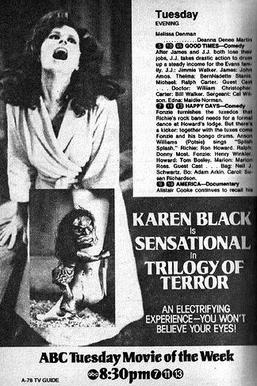
Trilogy of Terror (1975)


Trilogy of Terror
Directed by Dan Curtis
Written by William F. Nolan and Richard Matheson


Classic made for TV horror anthology, three stories, each starring Karen Black and based on stories by Richard Matheson, who I will always confuse with Robert Bloch.  While Karen Black is awesome in it, the fact that in each story she plays a mild-mannered woman with a dark, dangerous side makes the whole thing a bit samey.

Story one has a college professor being sexually blackmailed by her students.  Story two is a "these two people are clearly the same person with a split personality" joint, written so obviously I thought there must have been another twist coming.

But we came for the Zuni doll.  The last segment has Black being chased around her apartment by a tiny Zuni fetish doll in a sequence that many find terrifying but which is also objectively silly.  I got a new puppy right before watching this, so I was used to having something running around and slashing at your ankles.

Scarier than the doll was the creepy sexual subtext which I missed watching this as a child, with references to off-camera gang rape and incest.

On Amazon Video

Tuesday, May 8, 2018

The Devil's Breath by Robert Irvine

The Devil's Breath
by Robert Irvine
1982 Pinnacle Books


This book doesn't deserve this cover, so I'm going to go ahead and spoil the hell out of this one.

The book opens straight up with a "this is not a boat accident" followed immediately with "if you close those beaches, we're finished", so I figured we're in Jaws knock-off territory.  I one-handed artist returns to Moondance, Utah, where he finds the town council wanting to open a private hunting ground.  A Johnny Carson type is coming soon to film a hunting segment, despite his advance crew being brutally slaughtered.

We get about six hours of the artist feeling sorry for himself and the town council being jerks about him not selling his land.  Riveting stuff.  Johnny Carson and the lead characters head out into the woods where I hoped we would finally run into the giant bear or whatever, but shame on me for assuming - this is an Indian magic horror novel.  The group find an Indian who gets blamed for the murders, then people start dying from their greatest fears, like catching fire from fearing old age.  Look, they can't all be poetic.

Once we get down to our hero he discovers it's not Indian magic after all, Scooby, it's a mixture of hallucinogenic herbs that the Indian has been sneaking in people's water.  A mixture of peyote and whatever that drug is that guarantees an ironic suicide, the one in Young Sherlock Holmes.

Irvine should have gone all the way and had it all be a dream, seeing as how he was intent on killing off what little tension or horror he managed up to that point.

The audiobook didn't help as the reader paused way too long between lines.  At least a full second every comma and two or three every period, dragging this novel out to over eight hours.

Available for Kindle and Audible from Amazon

Click here to read a sample

Thursday, May 3, 2018

Genre Overview: True Crime

True Crime as a popular genre developed from pamphlets published in the 16th century, and is one of the first genres of literature consumed by the newly literate lower classes.  Sensational accounts of crime, mostly murder with the occasional rape or heist, often with little interest in factual accuracy.

Through the 19th century, true crime and detective fiction influenced each other.  Periodicals emerged: the Police Gazette (1845-1877) and True Detective (1924-), and Truman Capote gave the novel-length True Crime book some unearned credibility with In Cold Blood in 1966.

There's a blurred line between crime reporting and True Crime as we know today.  There are non-fiction books about crime and criminals which stick to facts in evidence.  On the other end, we have "based on a true story" and "ripped from the headlines" fare ranging from Dragnet to Law & Order.

And in between, we have True Crime, which tends towards sensationalism, artistic license, and just plain making stuff up.  The full books tend to be the worst offenders, probably from the need for padding.  Even if the facts are roughly accurate, the reader is given full quoted conversations and even interior monologues, which are clearly invented from whole cloth to give the events a narrative feel.

The audience for True Crime seems to have shifted dramatically in the last few decades - True Crime magazines were borderline softcore porn for men for over a century, but now the audience for things like Discovery ID and Serial seem to be more female.

There are a lot of elements I find distasteful in True Crime.  There's often a refusal to acknowledge police and prosecutorial misconduct and incompetence, and a smug sense of superiority over the loathsome criminal, which seems like an easy target.  There's a lack of ambiguity, as if all cases are not only solvable, but all facts are knowable, down to the thoughts running through a victims' head before they die.  And the padding, lord, the padding.  Very few cases have enough information to fill an entire book on their own.

In terms of non-fiction, I enjoy the Crime Library, which lives on thanks to the Wayback Machine.  Short on padding, long on gruesome detail.

For proper True Crime, my favorite era is the pulpy magazines, especially from the 1960s through 80s.  True Detective, Front Page Detective, Master Detective, etc.  These are consumed best, I find, like professional wrestling.  We know it didn't happen that way, but we're kind of pretending it's true for the story.  Read as fiction, I enjoy the stories as they don't conform with literary formulas.  I can usually guess the outcome of TV mysteries by counting the number of red herrings.  In real life (and fake stuff based on real life), people don't make any damn sense.  These are not bad people acting rationally in their best self-interest.  These are bad people acting impulsively because they're crazy and stupid.

By the 90s the focus, especially on TV, was towards the investigation and prosecution, but the True Crime magazines kept on the good stuff - the criminals and their crimes.  Unfortunately, these magazines do not have a high internet presence.  Ironically, there are more True Crime magazines from the pulp era available than from 40 years ago.

The best source I've found are in the "From the Files Of" reprints that came out starting in the 80s.  Names to look for include John Dunning, David Jacobs, Rose G. Mandelsberg, and Art Crockett.

Tuesday, May 1, 2018

The Lake by Richard Laymon

The Lake
by Richard Laymon
Leisure, 2004

I'd mostly given up on Laymon, but I ran across this as an audiobook at the library and figured I'd give it a try.  I don't learn very quickly.

A psycho killer who likes photography kills a prostitute.  Then young Deana is attacked while necking with her boyfriend.  He's killed, she escapes.

Deana's mom Leigh is sympathetic, as she had a boyfriend who was killed when she was her age.  Flashback time: Leigh is a hippie sent to Wisconsin to get away from bad influences.  She seduces Charlie, a simple teenage boy with an overprotective mother.  He dies falling over in an abandoned house.  That's the pay off for our 3-4 hour flashback.  Things do not pick up from here.

Leigh and Deana are attacked by a chef, Nelson, who Leigh fired from her restaurant.  They are then protected by a sexy cop Mace, who likes photography, just like our killer in the opening.  Leigh and Dean start dating, and he's into rough sex because he's a serial killer.  Laymon didn't bother to hide this fact, so why should I.

Deana gets over her dead boyfriend pretty quick and starts dating a bookstore owner, Warren.  This goes on for like another 6 hours.  Nothing happens.  An entire chapter is devoted to Deana getting back a knife and hat she dropped.  Nelson witnesses a woman getting eaten (?) by homeless people.  Deana is mobbed by elderly ladies from a rest home.  None of these things go anywhere.

Mace's former partner Maddie warns Deana that Mace is a psycho.  They break into his house and discover that Mace is Charlie's brother, and therefore Deana's uncle.  Mace finds them and admits to be a psycho.  They get police protection, and we get an entire chapter to the convoluted machinations Laymon dishes out to make sure Deana is alone so Mace can kidnap her.

Leigh and Maddie talk to a forensic psychologist who rehashes the self-evident reasons why Mace is a psycho.  Luckily, Warren's sister, Sheena, is psychic and knows where Mace is hiding Deana.  They rescue her without incident, and rescue the reader from any further possibility of horror or suspense.

The psychologist says Mace will go back to Wisconsin, and certainly won't try to kidnap Deana, so they leave Deana unprotected while Leigh, Maddie, and Sheena go to Wisconsin.  Leigh gets kidnapped, they confront Mace in the abandoned house where his brother dies, Sheena is Mace's brother, she fights him with karate, he falls through a hole in the floor and dies.

I guess he dies.  He was hanging onto the floor before dropping down the, what, three or four feet left to the basement?  We get a lengthy epilogue of how everyone's life is wonderful now, so we can say goodbye to these fully fleshed out characters who we've come to love so well.

This is reportedly Richard Laymon's worst book - I'm not reading all the others to find out.  There are inconsistencies with the setting.  At the end, the book says it was set in 1999.  Deana was 18 and conceived during the Johnson administration, placing this at 1987 at the latest.  Cops have pagers and Get Shorty by Elmore Leonard has to be special ordered at a brick and mortar bookstore.  But Fox Mulder is mentioned, and the characters watch Sleepy Hollow on TV.

My take - this was written in the 80s, shelved, and then half-assed updated and released after Laymon's death.

Available in ebook from Amazon

Click here to read a sample