Showing posts with label The Shadow. Show all posts

Thursday, September 12, 2024

The Shadow 2: Eyes of the Shadow by Grant Maxwell

The Shadow 2
Eyes of the Shadow
by Grant Maxwell
1931

Gangsters with a pet man-ape try to steal a hidden czarist treasure. Mostly it's Shadow operative Harry Vincent hanging around a cabin receiving orders over the radio. There's a squishing room death trap and an excellent shootout between the Shadow and a bar full of thugs shoehorned in to liven things up.

The first appearance of the Shadow as Lamont Cranston - I believe later it's revealed he took over the real Cranston's identity. His ability to melt into the shadows is unexplained, and he appears to have supernatural strength. He's not invulnerable - he takes a few bullets and is bed ridden for a couple scenes.

Check AbeBooks

Sunday, September 9, 2018

TM Gallery: Pulp


Weird Tales


Reprints from AbeBooks


Thrilling Mystery, March 1936
The Twisted Men by Hugh B. Cave The virus of idiocy was in the vile potion clutched in a dead man's hand. Cold Arms of the Demon by Jackson Cole Black Moonlight by G.T. Fleming-Roberts While forests burn, frozen corpses are found-and fanatic predicts the end of the world. The Howling Head by Beatice Morton Vengeance of the Snake-God by James Duncan Spider's Lair by C.K.M. Scanlon Blood of Gold by Wayne Rogers The Man Who Died Twice by Bret Altsheler 

Thursday, November 30, 2017

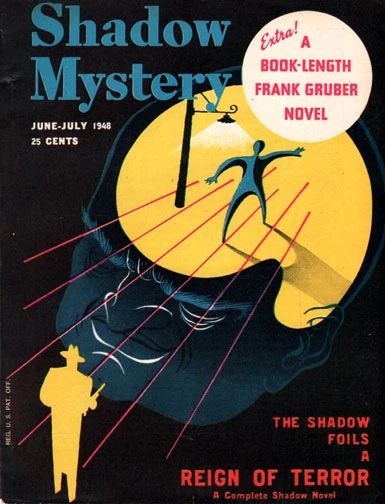
The Shadow 320 - Reign of Terror

The Shadow 320
Reign of Terror by Maxwell Grant (Bruce Elliott)
July 1948


I've read a few Shadow, each of them a little different vibe.  This is the first I've read which felt like one of the radio shows.  An extortion racket, led by an overweight gourmet, threatens a variety of citizens.  The Shadow tracks them to an underground lair and ends up trapped in a lion cage.  He escapes, in what I'm sure would have been an exciting sequence if it were on-page, and then talks everyone into killing each other.

Saturday, August 9, 2014

Shadow 043 - The Crime Clinic

The Crime Clinic
The Shadow 043
Shadow Magazine December 1933
by Maxwell Grant (Walter Gibson)


One of the unusual things about the pulp magazine version of the Shadow is that he acts through various surrogates.  Sometimes this is an interesting literary technique.  Other times, the story is an out-of-the-box mystery with the Shadow shoehorned in as an afterthought.  This is one of those times.

Two old chestnuts are dusted off for this one - a locked room mystery and a talking bird who holds a clue, neither of which are handled very deftly.

Most of the action is carried out by police inspector Joe Cardona and other surrogates, but the Shadow is present in every scene, as the story will constantly remind you.

The original cartoon version of the Hobbit had the annoying habit of having Bilbo take his ring off every time he spoke and then put it back on, in order to remind the audience that he's still in the scene but invisible.  The Shadow does this here, ad nausuem, and for no narrative purpose.  The story already tells us that he's sneaking around, but he actually steps out of the shadows to say "Here I am" before ducking back in, or lifts his disguise only to immediately put it back on.

This gets really bad at our denouement (spoilers)

Thursday, April 3, 2014

The Haunter and the Haunters; or, The House and the Brain

The Haunter and the Haunters; or, The House and the Brain
By Edward Bulwer-Lytton
1859, originally published in Blackwoods

Walter B. Gibson, creator of the pulp version of the Shadow, credits the influence of Bram Stoker's Dracula and Edward Bulwer-Lytton's The House and the Brain aka the Haunted and the Haunter.  From both there is an element of shadowy figures and mesmerism.  During a haunting scene there is even an apparition referred to as the Shadow, in capitals:
"Nothing now was left but the Shadow, and on that my eyes were intently fixed, till again eyes grew out of the Shadow—malignant, serpent eyes"
However, the pulp character began as a radio narrator and was named before Gibson's involvement.

The story is significant for being one of the first modern occult detectives, and is credited with being the first modern haunted house story.  It also bears some similarity to Richard Matheson's Hell House.

The story has our narrator volunteering to stay the night in a haunted house in order to investigate the phenomena.  During the course of the night he is overwhelmed with fear, sees mysterious apparitions in a surprisingly trippy sequence, and his servant flees the country to Australia, and his dog dies.